4 tips for the perfect customer service resume

If you're trying to enter the customer service field or change jobs within the industry, it's possible to stand out and make hiring managers choose your resume over others. Here are four tips to consider as you craft your resume.

Maintaining a basic resume template is important when applying to jobs; however, most career specialists recommend creating industry-specific resumes to appeal to the managers and human resource representatives who are reading them.

4 tips for the perfect resume

Customer service representatives are on the front lines of a company. They deal directly with customers and often have to diffuse stressful situations and solve problems quickly and calmly. If HR teams make poor hiring decisions for their customer care teams, then they could end with employees who make the situation worse and isolate customers. This is why the hiring and training process is so lengthy and involved for this department.

Quantify Your Previous Experience

When possible, include quantifiable information about your performance and your company within your resume. This helps HR departments understand how you performed at your job and what your workload looked like. While customer service is similar across companies and industries, each company has its own distinct expectations, too.
For example, the team at Zendesk conducted a survey to determine the average performance of customer service departments across the world:
The average customer satisfaction rate was 86 percent, and companies faced an average of 630 customer complaints that needed human interaction.
By sharing your personal customer satisfaction rate and listing how many calls or complaints you solved monthly, it's possible for your employer to understand how effective you were as a customer service agent. Your time on each call could also be an important statistic to include if it took several minutes or an hour to solve your customers' problems within that industry, in order to explain why you only helped about a dozen customers per day.

Specify What Technology You've Used

Historically, customer care representatives (CCR) relied on phone banks to receive their calls while upper management monitored their performance. However, today's customer care teams are responding to calls, answering emails, and engaging in customer chats all throughout the day. To manage these multiple forms of communication, companies have started to invest in various software programs like FreshDesk or LiveAgent.
Some of these software platforms actually use machine learning to move customers further down the sales funnel, so customer sales teams receive information about customers and potential solutions to their problems before they even say a word to them. If you've worked with technology like this before, it's important to list it on your resume.
When you start working at a new company in the customer service department, you will likely be trained on their software and internal tools. If you're already familiar with them — or have used similar programs — hiring managers could see you as an asset because you will pick up the job faster and will be less of a burden on the training teams.

Include Soft Skills as Well as Technical Knowledge

According to a survey by CareerBuilder, 77 percent of hiring managers value soft skills in an employee (i.e., the less tangible skills associated with an individual's personality) just as much as technical ability. This number might even skew higher for customer service agents who require strong soft skills to solve problems while representing the company.
hiring managers value soft skills
The Provide Support blog created an infographic with the top 20 skills needed to work in customer service and explained why each one is important. As you build your resume, try to mention a few of these soft skills along with the technical experience and training that you have. Many of these traits are actually buzzwords on a resume that hiring managers will be looking for when considering bringing you in for an interview. For example, you could say that you:
  • Listened to customer feedback and compiled reports for your managers.
  • Brainstormed creative solutions to customer problems that benefitted them and the company.
  • Led training exercises within your team to improve communication when relaying problem customers to upper-management.
While you're technically discussing your experience and sharing what you did in previous jobs, you're also highlighting your listening skills, creativity, leadership, and communication ability — all of which are soft traits your future employers will be looking for.

List Any Leadership Opportunities or Promotions

When you're creating your resume, you want to prove that you're dedicated to the companies you work for. No company wants to hire employees who will do the bare minimum and spend their days counting the minutes until it's time to go home. Instead, companies want people who will do their best and motivate those around them. If you're able to show that you're a dedicated employee, then your resume has a higher chance of making its way to the top of the stack, above applicants with the same skill set.
The average employee stays with a company for 4.6 years, with young people between the ages of 25 to 34 staying with companies an average of 3.2 years. Not only do hiring managers want someone who will stay for several years (and therefore reduce turnover and training costs), but they also want potential leaders. If your manager selected you for training or a leadership seminar at your last job, be sure to mention it in your resume. This shows that you're willing to stay at a company and that your manager thought of you as a key candidate for promotion.

Find out who is looking at your resume – and why

 
Your days of playing the guessing game when it comes to employers' interest in you as a candidate are over. Here's why.
You upload your resume. And then you wait. And wait…
And wait.
The hiring process has traditionally been a one-sided affair, with employers having the upper hand -- and job seekers often left wondering if anyone has shown interest in them as a candidate (or has even viewed their resume).
But no more.
As a job seeker, you no longer need to play the guessing game when it comes to employers' interest in you as a candidate. CareerBuilder has just launched some exciting new features that tell job seekers which companies are viewing their resumes -- and more importantly, why.

How it works

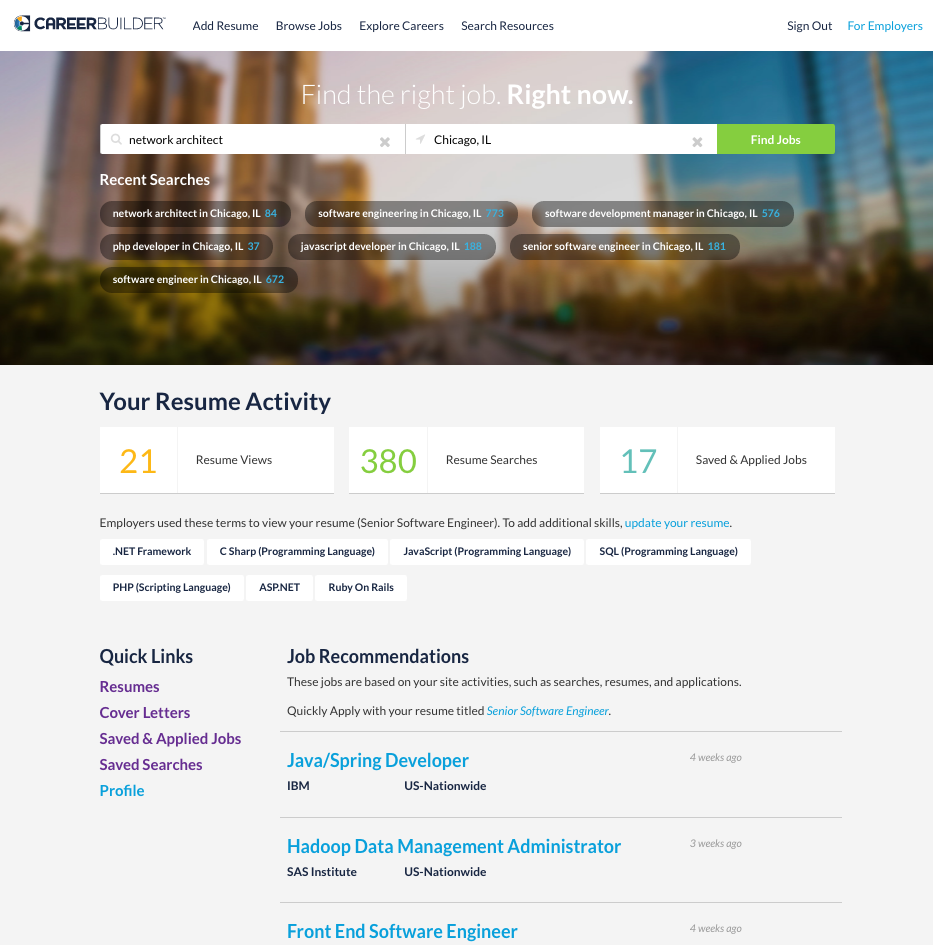
After you post a resume on CareerBuilder.com, simply visit the home page to see:
    • Your views: Up-to-the-minute information on the number of times your resume has been viewed.
    • Your search mojo: The frequency in which the resume has come up in company searches.
    • Why employers are viewing your resume: See the search terms an employer used to find you for insight into how and why you're showing up in their results.


Oh, and that's not all: You will also receive weekly emails highlighting the number of times your resume has been opened throughout the past week and which specific companies are looking at your qualifications.
Cue your happy dance.
We're really excited about this new feature, and hope you are, too: It gives you an unprecedented gauge of whether you have the right keywords in your resume to attract desired employers -- or whether you're off the mark and need to rethink your strategy.

Getting some bites?

If an employer has viewed your resume in our database, don't delay: "Quick apply," available on over half of our jobs, enables you to apply with the click of a button through either your desktop or mobile device. (Haven't uploaded a resume yet? It's easy.)
Matt Ferguson, CEO of CareerBuilder, also gives a sneak peek of more changes to come:
"In the future, we will also be providing recommendations to job seekers on which phrases they should use in their resumes to increase their chances of getting noticed."

Top 5 Keywords: To Use in Your Sales CV


The nature of a sales job means you should be able to sell, so your CV should reflect your skill. If you're having trouble selling yourself, you'll leave employers wondering how on earth you're going to sell their product!
We've compiled the top 5 keywords to include when you're writing a sales CV to help your CV stand out:

1. Financially Motivated

Someone who is inspired and enthusiastic about working hard to receive a financial reward.
Don't be afraid to use this phrase in fear that you'll seem shallow or greedy. The sales industry is all about making money, securing deals and of course; getting that commission! If you're financially motivated; the employer knows you'll be working hard to secure great deals for the company and a nice bonus for yourself too.

2. Resilient

Can recover readily from rejection, adversity or hardship.
Selling a product or service to someone who isn't necessarily interested or doesn't understand your product could lead you to a lot of 'thanks but no thanks' responses; so you'll need to be resilient and bounce back from the rejection.

3. Down to Earth

A sensible and practical person who is without pretence or one who is practical in their decision making and philosophy of life.
Having a down to earth attitude and sales technique will mean you're much more likely to get those sales. It can be good to have a quick anecdote that you can share with potential customers about your own experience, this could help people relate to you; and the product. However; if you don't have your own experience and you have to make one up; make sure its believable - test it on a few friends and see if that would encourage them to buy.

4. Excellent Communication Skills

The art and technique of using words effectively to impart information or ideas.
These transferable skills can be related to a role in any industry, but for jobs involving sales and communicating with clients; good communications skills are a must. Don't put on your CV that you have great communication skills if in the interview you're a waffling muttering mess. When communicating with anyone; be confident and concise.

5. Consistent

Unchanging in achievement or effect over a period of time.
Prospective employers want to know that you're going to continually deliver great sales results, smashing targets and exceeding expectations wherever you can. You can tie this in with your resilience; it's natural that you might have 'off days' where you won't perform as well; but it's important to know that you won't give up and you'll persevere to achieve.
When discussing your previous achievements; use action words. Rather than stating that you generated a lot of income for the company; state the exact figure! When stating that you continually over-achieved sales targets, use words like 'smashed' and 'maximised' to portray yourself as an active worker.

However; it's not enough to just list numerous skills and traits that you supposedly have! Only use these keywords if you actually have this ability. Ask those who know you best to come up with a few keywords to describe your personality and work ethic.

17 Successful Executives Who Have Lied On Their Résumés

Mid-level workers aren't the only ones fudging their experience


5 Resume Mistakes That Scream 'Narcissist'

Let the recruiter decide if you truly are creative, innovative or exceptional.


Most people hate writing their resumes. The idea of having to sell yourself with a piece of paper can feel really intimidating. Between the formatting and the content, creating the perfect resume can feel overwhelming and frustrating. Even worse, as you send out the resume and receive no responses back, you start to doubt your design. Next thing you know, you're making tweaks and changes, obsessing over why the resume isn't making your phone ring.

Resume trends have changed dramatically in the past few years. Recruiters have high expectations. They're also time-crunched. They need resumes they can quickly skim to determine if you're a fit. Did you know that studies show recruiters spend an average of only six seconds on your resume to determine if you're a fit? Which means that first impressions matter.

Unfortunately, many job seekers aren't getting a second opinion on their resumes, ultimately creating one that mistakenly screams, "I'm a narcissist!" to recruiters. I spoke with TopResume's job search expert, Amanda Augustine to get her take on how job seekers are going wrong. Here are five things she says you should never do on your resume:


1. Leading with a "me, me, me" objective statement.


Recruiters don't care about your career objectives. They have a job to fill and you are just a potential service provider. Augustine explains, "When the first thing a recruiter sees on your resume is what you want from them, they're turned off." Ditch the wordy, self-important objective statement and free up that valuable real estate on your resume for proven accomplishments instead.


2. Overselling yourself with subjective text.


When you use words like "creative," "innovative," and "exceptional," you're sharing opinions of yourself. The recruiter sees it as his or her job to determine if you are those things. When you say it about yourself, you sound cocky. Augustine says a good test is to ask yourself if you'd say these things when speaking face to face with a recruiter. "Hi, I'm fantastic Amanda!" would sound pretty silly. Tone down the language and stick to the facts instead.


3. Adding a picture.


While a photo is normal to add to a social media profile, it's not acceptable on a resume. Augustine says recruiters don't want to be distracted by the photo. Plus, you could be setting yourself up for discrimination. Let your accomplishments speak for you, not your looks.


4. Getting too personal.


Recruiters don't want to know about your wide-variety of extracurricular activities. Augustine says, "It's a resume, not a dating profile." Recalling that recruiters spend only six seconds skimming your resume, it's better to leave off anything that isn't truly relevant to your professional experience.


5. Showcasing quotes and references.


Testimonials are for book covers, not resumes. First, recruiters have no way to prove if they're real. Second, they take up valuable space on the resume. Augustine says featuring references from co-workers and managers screams, "I'm trying too hard to impress you." If the recruiter wants them, he or she will ask for them.

If you're guilty of any of the above, you may want to rework that resume. Also, consider seeking out some tools to help you evaluate objectively what else might be missing the mark with recruiters. Think of yourself as a business-of-one and the resume as the brochure. The messaging needs to resonatewith your intended audience, or you'll be dismissed.

14 of the Most Ridiculous Things People Have Put on Their Résumés

Hiring managers revealed résumé mishaps that ranged from inappropriate typos to blatant lies.


"Job seekers understand that there is a lot of competition for jobs today; therefore, they are trying more unconventional methods in effort to stand out and grab the hiring manager's attention," says Rosemary Haefner, chief human resources officer at CareerBuilder. "These efforts may also likely be misguided attempts to compensate for lacking 10o% of the qualifications specified in the job posting."

But job seekers should try to stand out for the right reasons, she says. Instead of making outrageous claims or lies, focus on what you are good at and what you have accomplished.

"Hiring managers are more forgiving than job seekers may think," Haefner explains. "About 42% of employers surveyed said they would consider a candidate who met only three out of five key qualifications for a specific role."

For its survey, CareerBuilder asked more than 2,000 hiring managers in the US to share some of the most memorable things they've seen on résumés.

Here are 14 that really stood out.
  • Applicant claimed to be a former CEO of the company to which they were applying.
  • Applicant claimed to be fluent in two languages — one of which was pig Latin.
  • Applicant wrote "whorehouse" instead of "warehouse" when listing work history.
  • Applicant's personal website linked to a porn site.
  • Applicant vying for a customer service position gave "didn't like dealing with angry customers" as the reason for leaving her last job.
  • User name of applicant's email address was "2poopy4mypants."
  • Applicant claimed to be a Nobel Prize winner.
  • Applicant claimed to have worked in a jail when they were really in there serving time.
  • Applicant who claimed to be HVAC certified later asked the hiring manager what "HVAC" meant.
  • Applicant said to have gotten fired "on accident."
  • Applicant claimed to have attended a college that didn't exist.
  • Applicant for a driver position claimed to have 10 years of experience but had only had a driver's license for four years.
  • Applicant listed as a reference an employer from whom they had embezzled money and had an arrest warrant out for the applicant.
  • Applicant's stated job history had him in three different companies and three different cities simultaneously.

17 Successful Executives Who Have Lied On Their Résumés

Mid-level workers aren't the only ones fudging their experience


The 8 Biggest Mistakes on Resumes, and How to Correct Them

When you’re an entrepreneur, you do a lot of searching for the right candidates to join your team. Hiring takes up a tremendous amount of time, so one of the best things you can do if you’re looking to get hired, or you’re looking to hire someone, is to pay attention to the common mistakes on resumes.
As a job seeker, keeping these mistakes off your resume will help you get through the stacks of applicants to potentially get hired at a great startup. As a hiring entrepreneur, identifying these key mistakes early on in the resume process will save you time as you sort through applicants.
Here are the eight biggest mistakes I see on resumes and how you can correct them.

1. Saying too much

Having a lot of experience is a great thing. However, put yourself in the mindset of the person hiring and take a good overview of your resume’s length. I typically like to see nothing longer than a page, maybe a page and a half, but really you should try to pare it down to a page.

People will fight me on this all the time and say they have so much experience that it simply won’t fit on one page. My argument is that when a candidate can show me that they can succinctly and effectively summarize their experience onto one page, it demonstrates you already are practicing two important skills you need at any startup or business. Also, don’t be afraid to put your LinkedIn profile link on your resume, and then list all the details there on your LinkedIn page, which will be the second place I go after reading your great, brief resume.
It’s always best to think of your resume as a job eliminator, not a job getter. I want to see if you have core competencies that match my team needs, then I’ll dig deeper with a LinkedIn search, phone interview or email after you’ve made the first cut.
Saying more of the right thing in less space will get you further with your resume.

2. Saying too little

Obviously, the flip side of too much is not saying enough. You should have a complete, robust page offering that gives the best details and the most statistically significant information about your past. Include metrics. I’m always amazed when resumes are filled with flowery language about “tasked with” this job and “responsible for” that initiative, but then there’s no data to back it up.
How many files did you reorganize into a complete new system? How many sales did you increase from quarter to quarter? Put metrics in the mix and also include any leadership or management positions.

3. Skip objectives

There’s an old school of thought that objectives should be listed at the top. I’m not in that camp. I don’t think the objectives section of your resume is relevant or important at this stage. When you’re in my office and we’re interviewing together, I like to talk to you face to face about your objectives. All this does on your resume is take up space on your one-page, metrics-driven resume. Skip it and save the space.

4. Grammar

Did you know grammar and spelling are two different things? You can spell its correctly and still be using the wrong form of the word grammatically. There are their, there and they’re, as well as multiple uses for you are and yours, apostrophes, colons, semi-colons and more (oh my!).
Understanding grammar, verb-noun subject agreement, propositions and plurals are all basics of the English language that your spell check isn’t going to find each time. Have a second set of eyes read your resume and check for grammar.
One trick I always use is to read anything I write out loud. Read out your contractions to make sure they make grammatical sense in your sentence. That extra step of care shows me that you are considerate and deliberate in the quality of your work. Trust me, many aren’t, and your resume will do better.

5. Spelling

Spelling, like grammar, matters. Spell check and auto correct aren’t going to get it right 100 percent of the time, so make sure you read it out loud and have a second set of eyes on your resume for spelling as well. It will make a difference.

6. Gaps

Aside from metrics on a one-page resume, the other big thing I’m looking at are the timelines. If you have big gaps in your employment timeline, that’s not an automatically bad thing, but you should offer some kind of explanation. Gaps of more than about six months should either have an explanation in your cover email/cover letter or should include an entry on your resume timeline, like explaining that you took time off to travel the world, or started a business that failed.
Whatever it is, those are important and relevant details that can fill in a complete view of your history. When I see big gaps in a resume’s timeline with no explanation, it makes me wonder what was going on and why you wouldn’t mention it. It’s a distraction in a resume.

7. Inconsistencies, embellishments and lies

Don’t lie on your resume. It’s that easy. Actually, don’t lie in life at all. Trust me on this. It’s obvious when your years of experience don’t add up, when your timeline is all over the place, when you have massive unexplained jumps in responsibility or hop from job to job.
Inconsistencies and dramatic embellishments are white lies and I’ve seen it all from white lies to full-blown fiction on resumes -- don’t do any of it.

8. Relevancy

My final word of advice on resumes is to make sure yours is relevant to the position you’re applying to, or else don’t bother. If I am having a medical emergency, but happen to know an incredibly talented engineer, that doesn’t mean I’m going to stop by his place for medical care -- I need a doctor!

The same goes with your resume and applying for employment. If your skills really don’t match up to what the job requires, even if you are really smart, talented and have great experience at what you do, it’s just not a good fit. Save both sides of the table the time and don’t apply.

Courtesy: foxnew

9 Steps for Figuring Out Which Skills to Include on Your Résumé

Learn to intuit what recruiters are looking for


1. Consider some of the most common skills recruiters search for.
"The most common skills people forget to showcase are the transferable skills that recruiters use general search terms to find — things that can be measured," says J.T. O'Donnell, a career and workplace expert, founder of career advice site, CAREEREALISM.com, and author of "Careerealism: The Smart Approach to a Satisfying Career."

These include:
  • Software you are proficient in (MS Word, PowerPoint, Excel, Office)
  • Project Management
  • Marketing
  • Sales
  • Customer Service
  • Budgeting
  • Recruiting
  • Management
2. Specialize your skills.
The skills recruiters look for when they scan through résumés depend on the type of position they're trying to fill, says Rita Friedman, a Philadelphia-based career coach.

For example, if you're applying for a position that requires technical knowledge, include specific examples of technology or equipment you use, even if it could be reasonably assumed you must know these things, Friedman suggests.

3. Scan through a ton of job postings.
"To ensure that you're including relevant information on your résumé, carefully review job postings and highlight the parts that make you say, 'Oh, I do that all the time!'" Friedman suggests. "When you're writing your own resume, it can be hard to be objective, and you may forget about things that you're so good at doing they come to you automatically."

4. Research people with the jobs you want.
Friedman and O'Donnell both suggest checking out the LinkedIn pages of people whose jobs you'd like. Check out their "Skills & Endorsements" section and identify which ones you could justify putting on your profile too.

5. Diversify your list of skills.
"When evaluating a résumé, recruiters are looking for two big qualities: hustle and curiosity," says Kate Swoboda, creator of the Courageous Coaching Training Program.

She says employers today are looking for résumés that demonstrate the person takes initiative and is motivated by curiosity.

"These days, coders are now expected to interact with clients, and the person in charge of crafting the company's next great tweet might also be called upon to help with some aspects of visual design," Swoboda explains. "Recruiters are looking for people who are curious enough and motivated enough to go beyond their technical job description because that adds more value for a company."

6. Don't be afraid to make it personal.
"I'm very much in the camp of not hiding your personal life, skill set, and interests from a prospective employer," says Michelle Ward, a creative career coach and co-author of "The Declaration of You!"

She suggests including skills you've learned from outside passions, whether that includes owning an Etsy shop or planning your best friend's wedding.

"I think, more and more, companies want to see a well-rounded, inquisitive, personable candidate that is right for the job and would be someone interesting to have in the office," she says. "Just make sure to relate that experience back to how it'd be value for the company/position you're applying for."

7. Consider what you're proud of.
Friedman suggests you make a list of the things you're especially proud of accomplishing in your jobs and then think about what skills you used to accomplish these.

"If you reduced the amount of time it takes to complete a task, you may have strong skills revolving around process improvement or automation," she says. "If you got back the business of a former client who left, you may have a talent for repairing damaged relationships."

Ward adds that you should ask yourself, "What do people thank me for? What do I get complimented on, repeatedly?"

8. Quantify your skills.
Before you add any skills to your list, O'Donnell suggests you ask yourself a number of questions like:
  • How many projects have I led?
  • How many people were on the team?
  • How many customers were affected by my work?
  • How many people did I train?
  • How much money was involved?
  • What kind of results/savings did I get?
"If you ask yourself enough of these, you find your way to validate and quantify your experience in a way a recruiter can understand," she says.

Friedman agrees and says it's always better to show rather than tell on your résumé.

"For example, if you're in sales, you don't just need to hit keywords like 'business development' or 'consultative selling;' you need to have quantifiable examples of your skillset in action: 'Increased sales over previous year by 63%.'"

9. Talk it out.
In determining if you have the skills necessary, when creating a résumé, talk about your experiences out loud with someone, preferably a professional or someone who has work experience," suggests Alyssa Gelbard, founder and president of Résumé Strategists.

"They hear things differently and can help you translate your internships, jobs, extracurricular, and educational experiences into important skills for a potential job."

Tips for Making Your Resume Stand Out


In a competitive job market, how can you make sure your resume gets noticed?
Your resume may be the first impression a potential employer will have of you, but in order to achieve that, it has to actually make an impression. Hiring managers see a lot of resumes, which means not only does yours need to have strong content and be presented clearly, but it also needs to be memorable and catch an employers' eye.

Here are some tips on writing a resume that will stand out from the pack:

Less is more
Be careful not to overload your resume. Cramming as much information about yourself as text size and margins will allow makes it more difficult for the hiring manager to find the most relevant information.
"Remember the purpose of the resume is to get you the interview. Don't load up the resume with everything but the kitchen sink," says Paul McDonald, senior executive director at Robert Half. "Instead, put enough detail in the resume to make a hiring manager want to learn more."
Keep in mind, employers tend to have quite a few resumes they need to look over, and thus don't tend to spend much time on any individual resume – at least in the early stages of the application process. The easier your resume is to read, the more likely it is to actually be read.
"Use short bullets that someone can easily scan," suggests McDonald. "An easy-to-read resume that shows a hiring manager you're results-oriented and can do the job will help move you to the 'need to interview' list of candidates."

Customize to the job requirements
No two jobs are exactly alike, and the resumes you submit shouldn't be either. Employers like to know that a candidate is legitimately enthusiastic about the open position, and submitting a cookie-cutter resume with irrelevant information sends the message that you didn't put in much effort.
"As a job seeker, your resume should be modular – able to be adjusted and tweaked to fit the job requirements. A one-size-fits-all resume is like job seeking with a blindfold on," says Lida Citroen, owner and principal of branding and marketing firm LIDA360. "Hiring managers and recruiters are often overwhelmed with resumes for open positions. The easier you can make their job, the more likely your resume will get reviewed."

Highlight achievements
In order to stand out, it's not enough to simply list the skills you have that match up with the employer's needs. Provide evidence that you do, in fact, possess said skills, and examples of how you've put them to use in the past.
"Frame your work experience with quantifiable or specific business outcomes you've helped achieve. For example, rather than 'opened new accounts and sold into existing customers,' consider noting you 'developed a new business pipeline of $3 million and secured 18 new clients,'" says Daphne Wotherspoon, managing director of the IT practice at HireStrategy. "It makes your professional accomplishments more tangible for hiring managers."

Web presence
Where resumes once provided job seekers the ability to manage the information prospective employers had on them, in the Internet era, that's no longer the case.
"The Internet IS your resume," says Karen Cahn, CEO of Vproud TV. "It's dated to think that the 1 sheet of paper you write your credentials on is the only thing that matters. It's only part of the story. Your online presence is just as critical."
Even with the additional information employers can find via the Internet, your resume is still a crucial tool. "A resume is a part of your toolkit, not the entire solution," says Citroen. "Successful job seekers build their personal brand and reputation and have a resume, which serves as an extension of all that information."

Resume Reboot: How to Take Your CV From Decent to Dynamite

Make the most of your minute on a recruiter's desk


Now comes the "how" of getting noticed. Let's simplify and think of a resume in terms of structure and content. There are those of us who work with the standard format and others like the applicant at Airbnb who took her resume to a whole different galaxy. Not to worry, you don't have to go there. (Though kudos to her for her hard work and determination.) However, you do want to get noticed, and here are some key strategies to make that happen.

"Don't sell yourself short," says Heidi Duss, Founder of Prepster, a company dedicated to helping individuals make the best first impression. "A resume ... helps a potential employer understand your achievements and successes throughout your career." And on the subject of success, Duss emphasizes putting modesty on the back shelf and, instead, owning it. It's the fruit of all your hard work, right?

"Think back to the achievements that made you an asset to your previous employers," says Duss. "Consider not only what you did but also how it was achieved." Remember to use the power of "X" by "Y," when describing your accomplishments, as in, "I increased our bottom line by 40% ("X") by fine-tuning our SEO strategy ("Y")," instead of just "I increased our bottom line by 40%."

Show numbers as much as is appropriate. People like numbers because they help set up a context for what you are describing. As an example, if you did a special internship or got into a competitive program, don't forget to describe that you were selected out of "X" amount of other candidates. This helps to give a sense of the kind of selectivity you were up against.

Also remember the power of using keywords associated with the job description in your resume. Think of how you scan articles when you're looking for a particular subject matter. The same goes with recruitment. Use your words strategically.

Why One Professional is Sending Out a Resume Full of His Failures Bad References and Non-Skills

Jeff Scardino's shockingly honest LinkedIn profile


If you take a look at his personal relevant résumé below, you'll learn that he has worked on several losing pitches, cannot remember names, could be more punctual, and dated a free-spirited girl at Ohio University who ruined his junior year.

Scardino has always been intrigued by the résumé, but this idea for an alternative, brash template emerged recently when he was helping out with his company's hiring process.

He couldn't stand to see another traditional, plain résumé or talk to yet another highly approving reference. He wanted to see failures and talk to the people who didn't like the candidates.

"That's more interesting to me," Scardino tells Business Insider, "and it's even more interesting if the candidate is willing to give you that information. For someone to be that transparent and that much of an open book says a lot about them and their confidence."

Scardino stripped down his own LinkedIn profile so that it features only his relevant résumé:
Jeff Scardino

While he chose an extreme approach, "realistically it's just a compliment to your LinkedIn profile or traditional résumé," Scardino explains.

It's a creative way to get your foot in the door, he believes, and once you land the interivew, you can follow up by presenting tangible skills, explaining why you chose to highlight certain failures, and what you learned from overcoming them.

The next step is putting his theory to the test. Scardino plans to conduct a social experiment, in which he will apply to several job openings using his relevant résumé.

Super Bowl Victory and the 394th Resume

Job search lessons from the Patriots' big win


Indeed, Butler is now a hero until Super Bowl 50 because the Patriots were leading at that moment thanks to the play of their marquee athletes. They simply would not quit. Not one of them. They "refused to loose," as Saint Louis head coach, Jeffrey Michael Fisher, coined the phrase. Fisher, to be accurate, coined the phrase when he was head coach of the Tennessee Titans who refused to refuse to lose and came up one yard short of winning Super Bowl 34 in 2000; losing to (you guessed it) the Saint Louis Rams.

On January 30, 2000, Tennessee Titan quarterback, Steve McNair (since tragically deceased) completed a last-second pass to wide receiver Kevin Dyson at the one-yard line. Unfortunately for McNair and the Titans, Saint Louis Rams linebacker, Mike Jones, tackled Dyson a half-yard short of the goal line, preserving the Rams' 23–16 victory. A clutch defensive play not unlike Butler's last night.

As the Titan's proved, just having a catchy mantra doesn't mean you follow it.

I started out of college and sent out 394 resumes from the time I graduated until I received my first job in Los Angeles television with KNBC six months later. I went on to enjoy nine years with The Disney Company and later, McGraw-Hill and Partners in Human Resources International in New York City.

That's relevant because there would not have been a career for me at Disney or beyond if I had quit after I mailed the 393rd resume. It took 394 resumes before my name rolled across the closing credits of my first NBC television special. Who knew?

The take-away message that every one of us should cherish from Super Bowls 34 and 49 is that, no matter how hard you have fought or how diligently you have persevered, victory might just be one more snap away. That's the eternal promise to the job seeker: one more resume, one more application, or one more contact might make the difference, be the one, or seal the deal.

Tom Brady, one of the most celebrated football heroes in the game, raised his hands in victory moments after Malcolm Butler, a relative unknown until that decisive moment, made the play that sealed the victory. (I'd like to be Malcolm's agent Monday morning.) But it was Brady, and the rest of the Patriot's roster that earned the victory, even after Seattle played heroically and good fortune bounced their way almost often enough to win.

Worst Resume Mistakes You Can Make

Remember to focus on your target audience


closeup of resume objective and Experience
Can you spot what's wrong with this resume?

It's likely most job seekers have heard about a prominent figure losing a job as a result of a resume lie written early in his or her career. This kind of huge mistake attracts a lot of attention. However, most "worst" mistakes aren't headline grabbers or news stories; they are mistakes almost every job seeker makes when on the prowl for a new opportunity.

If you have a resume, and it hasn't been professionally written, one of these "worst" mistakes likely lurks in your materials.

It's all about you.

This category of error can be one of the toughest to identify, because you think your resume is all about you. Think again. In fact, while it is a document to market your accomplishments, your resume's job is to connect with the hiring manager. To be most successful, it should appeal to its target audience.

Check your resume for these overly self-centered red flags:

An objective. "A position with a growing company where I will feel fulfilled and get experience necessary to achieve my goals." While most objectives are not quite so self-centered, the nature of the objective is that it focuses on the job seeker and not the employer. Regardless, the objective is a dated vestige of resume days gone by; avoid it in favor of a "headline" and quick bullet points that clearly connect with the employer's needs.

"I, me or my." While some resumes break this rule successfully, in general, resumes should be written in the "first person implied." For example, "Oversaw 50 employees" instead of "I oversaw 50 employees." If your resume is peppered throughout with self-referential language, it will probably strike the reader as a bit "me centric." (Note: keep this in mind for your cover letter, too. While you can say "I, me or my" in your letter, make sure you aren't beginning every sentence with "I.")

Oversharing. It's very nice that your family is the most important aspect of your life, but the resume isn't the place to discuss it. Incorporating too much personal information, especially when it is not a requirement of the job, is a key indicator of the job seeker's preoccupation with what he or she wants or needs. In the U.S., resumes should never include personal information, such as age, marital status or religious affiliation.

Seeking experience. It's the very rare employer who wants to hire someone who does not already have the skills necessary to do the job. If you are looking for experience, that is fine, but keep it to yourself and focus on the skills you do have to help qualify you for the job.

Careless Errors

The biggest category of resume mistakes are the ones you will probably never notice when you edit your own document. These resume killers don't make the nightly news, but they are your job search's worst enemy.

Careless errors. Spell check does not catch all spelling errors; do not rely on it to proofread your resume. Ask an eagle-eyed friend or take other steps to edit your materials. For example, try reading it backwards, print it in large font and read the words aloud to a friend. Sometimes, you'll be able to catch misplaced words and spelling or grammatical mistakes.

Formatting. While resumes may have their formatting stripped for an initial read via an applicant tracking system, it's possible your actual resume may make it into the hands of a hiring manager. If you have an awkward page break, too many fonts or inconsistent formatting or spacing, the hiring manager may decide your lack of attention to detail disqualifies you for the job.

Missing the Point

Your resume's goal is to convince the hiring manager of your qualifications. Your job is to submit a resume that clearly conveys how and why you are a good fit. Unfortunately, many job seekers make the big mistake of failing to read the job description. (Learn about other killer job seeker mistakes .)

Target your materials. Read the job description carefully and decode what the employer seeks in an ideal employee. (Review my series of "Job Descriptions Decoded" for advice and specific information about how to successfully target your resume.)

Unnecessary details. No, you don't need to list every job you've ever held for the past 25 years on your resume. Generally, it's appropriate to include the last 10 or 15 years of experience, but be sure to focus on the most relevant experience. Especially if you're transitioning to a new field, feature the experience in past jobs that's more relevant and interesting to your new target employer. Don't spend a lot of time listing things you've done that have nothing to do with your goals.

Include accomplishments and skills. Resumes that are a laundry list of "stuff" usually fail to make the cut. What you've done in your past may be relevant, but don't forget to incorporate language addressing your skills and accomplishments. For example, if you worked on a team, make a point to indicate your specific role in the end product.

When you write an error-free resume that accurately portrays your experience and takes into account what the employer hopes to see, you'll be way ahead of the competition.

4 Tips to Get the Mediocre Out of Your Resume

Take a cue from your high school English teacher


Resume written on old typewriter

As we were growing up, our mothers dutifully worked hard to make us humble, hardworking, good team players, and punctual. That's fine and good, but if you dare put any of those characteristics on your resume, either in a summary or listing of capabilities, you are effectively guaranteeing that your resume will be tossed rather than read. Your resume is your shot at showing why you're special, not how well you were brought up. Unfortunately, too many people write their resumes as if their mothers (rather than hiring managers) were reading the document.

When crafting a resume, turn off your mother's voice. Ironically, all the characteristics that might make you a great human being translate on a resume to a potentially mediocre and boring employee. Your assignment in writing your resume is to paint a compelling picture of why you're a phenomenal candidate. No one is perfect, but you should be exciting, amazing and someone that the hiring manager just wants to meet. It's all in the words and phraseology that you choose to describe yourself.

Example: At the very top of his resume, one friend listed the following as his main qualifications: "Solid organizational skills, good communication skills, knowledgeable in social media."

Can you spot the implied mediocrity in his choice of adjectives?

If I'm hiring a coordinator or administrator, I want them to be great at organization and amazing at communicating with clients and customers. If I'm hiring a social media assistant, I want the person to be far more than just "knowledgeable." My grandmother is knowledgeable about Facebook. My social media assistant is a whiz kid.

Luckily, there are many tools today to help you turn yourself from just another nice person into a serious prospect worthy of consideration for an open job. Here are a few of them.

Remember your high school English teacher and use action verbs. Every year there are standard resume buzz words and loads of advice on how to use them or abuse them in a resume. For instance, check out these research results from a CareerBuilder survey that show common resume terms that make recruiters cringe.

Instead of buzz words, consider sprinkling your resume with power words, verbs that put oopmh or action into your resume. Here's where high school English class comes in handy. There are distinct differences between adjectives and verbs in resumes. Verbs are true power words generally showing you can get things done. Examples include: launched, managed, led, developed, and created, to name a few.

Contrary to power verbs, buzz words are frequently overused adjectives such as unique, detailed, solid, good, adaptable or flexible. These words imply that you don't have results to report and are punting to describing yourself instead of your work.

Think of your high school math teacher and show your work. Contrary to popular belief, your resume is not about you. It's about your work. This is the most common mistake I see on many resumes sent to me for review. Worse, I usually see this error at the very top of a resume in a summary that describes the person and what she wants in a job rather than the prospect and what he can bring to the job.

The person: Dependable team-player interested in working in a challenging environment
The prospect: Effective project manager known for motivating teams under tight deadlines.

Resumes are your chance to "show your work." Your work--not your self-descriptions--should make you shine. That's why numbers that show results are so powerful. For instance, which employee are you most likely to invite for an interview?

Person A: Dedicated salesperson with exceptional attention to customer service and meeting all
sales quotas.

Person B: Effective sales representative who grew accounts by 10 percent in three months and created a new sales category to grow business by $25,000 in the first quarter rollout.

The math wins every time because it goes beyond describing you as a person, and instead shows the results of your work.

Show your varsity letter. Mom taught us how to be nice people, and we frequently hear how people like to work with people they like. Certainly, hiring managers don't want to hire difficult personalities, but before they spend even a minute assessing your personality they first want to know if you're a great prospect who can do the work, get the work done, and not be undone by the work in high-pressure situations.

You can be the best team player in the world, but the hiring manager needs specialists in building her team. Generally, we make the mistake of selling ourselves as a cheerleader when the team needs a solid quarterback to call plays, or a broad-shouldered offensive lineman who can take getting bruised, or even a flexible goalie who can keep his eye on the puck and where it's likely to go.

It's important to know the role you're interviewing for and how you have trained to perform that very position for the good of the team. That is very different from being a team player.

In summary, remember the old saying "it's business. It's not personal." Your resume is about you as a business person. Although it's a reflection of you, it's not about you. It's about your work and how you're effective in a business environment. Use your resume to show what you've done and how you've done it. You can let your smile and handshake in the interview show them you're a nice, solid, stand-up kind of person. You need your resume to first get you in the door to that interview. Mediocre and nice won't cut it.    

25 Great Resume Templates For All Jobs

Your internet search for 'resume templates' ends here


Close-up Of Young Businesswoman Reading Resume At Desk


We've all scoured the internet for "resume examples" or "resume templates", but let's face it, usually the sample resumes you find are too generic, not appropriate for your field, impossible to download, or simply ugly. Luckily, template provider Hloom has put an end to your frustration. They've created a great collection of 277 free templates.

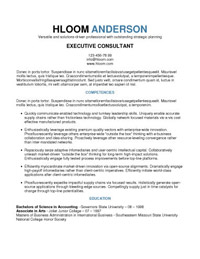
The Hloom page is easy to navigate and all the templates open in Microsoft Word. However, there's still an overwhelming 277 different templates to sift through, so AOL Jobs has made it even easier. We've selected our 25 favorite templates from Hloom. These 25 templates include appropriate examples for positions in finance, admin, graphic design, academia, and more.

Some of the designs we selected are traditional and some are more creative, but all have smart and clean designs. All successful resumes should be visually appealing to the hiring party and clearly highlight your qualifications in an organized way.

Classic
These clean, modern designs can work as resume templates for most jobs, from creative positions to corporate ones.


Finance and Business
Whether you're an executive, or just aiming to be one, these templates reflect a professional and strong candidate.


ATS Optimized
Hloom has a great section of ATS Optimized resumes. These layouts use prominent headers and traditional fonts. They are designed to potentially insert keywords that relate to the job posting near the top. They do not use graphics, borders, tables, or any other design elements that might be difficult for a computer applicant tracking system to interpret. The layouts themselves are also ideal for clerical and administrative jobs.


Entry level
Even if you're just entering the workplace, a recent college graduate, or making a career change, you can still have a great resume. Here are some templates for candidates who might be light on previous experience.


Creative and Academic
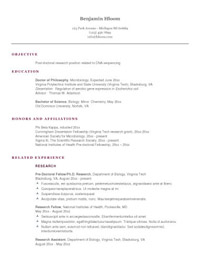
If you're applying for a job in a creative field, you might be seeking a template that has a bit more flair. The first template is suited for an actor, gallery artist, or any position that prioritizes listing creative work over descriptions of work experience. The last template is for academics or anyone who needs a resume that lists research and publications.


Browse all 277 Free Resume Templates at Hloom.
              

Beware of These 4 Grammar Mistakes on Resumes and Cover Letters

Chek evry sentence real careful-like


correcting grammar and spelling ...


In Larry Beason and Mark Lester's book, "A Commonsense Guide to Grammar and Usage," the authors understand that sentence diagramming and tense agreement may not be issues that most people are concerned with in their writing. However, that doesn't mean that writing well has to be difficult. "Avoiding errors is not the most important aspect of writing effectively, but it is important enough to deserve writers' attention," they write. And if you've ever written a cover letter or resume that claims you have "excelent attention to detail," but misspell excellent, you can understand why presenting yourself as a smart, capable worker who can communicate effectively is important to hiring managers.

That being said, there are four grammar mistakes that seem to haunt job seekers and workers alike. Whether you're sending an email, formatting your resume or drafting a cover letter, these are the four areas that deserve a proofread before you hit send, save or print.

1. Eliminating sexist pronouns
Most job-seeker materials will cite specific examples of your work or of people you know, so using gender-specific pronouns like he or she is a must when writing. But in emails or speaking about broader topics like industry or management trends, it can be easy to generalize in sentences like, "Each person should try to do his best." The problem is that gender-specific pronouns can create or reinforce biases in people's minds, which clouds your writing and degrades the message you're sending.

To correct this issue, Beason and Lester's write, "See whether you can make the subject of your sentence plural and change the gender-exclusive pronoun to the plural form (they, them or their). Try substituting his or her for a gender-exclusive pronoun when the subject is singular. [Or] revise the sentence to avoid using personal pronouns altogether."

2. Apostrophes in contractions or showing possession 
Contractions such as can't instead of cannot help writing sound more familiar and informal, which can coax your reader into a more relaxed and understanding mood. And citing ownership of a project ("The communications team's presentation went well") is a common scenario in writing. Unfortunately, when writers aren't sure of the rules apostrophes follow, they often abuse the punctuation mark and opt for overuse versus an embarrassing omission.

The authors' advice: "If you use a contraction, it'll need an apostrophe." For possession, "Check carefully each use of its and it's in your writing. If you are indicating possession, there is no need for an apostrophe [with its versus it's]. However, if you are using a shortened form of it is, you need an apostrophe to take the place of the missing letter."

3. Capitalization
Typically, job titles are capitalized on resumes when you're listing your experience and the companies for which you've worked. But if you're writing about truck drivers as the profession, not the specific role that you had, you wouldn't capitalize the term. Confusing? It can be.

Really, you want to minimalize capitalization because it demands importance and attention, which should be saved for your titles and not every reference to the profession or industry. The authors write, "Although capitalization errors can easily occur, it is important to avoid them. Frequently, capitalization errors – like spelling errors – jump out and distract readers from what a writer is saying." For your credentials, the authors recommend to "Capitalize the names of actual courses, schools and subjects. Do not capitalize when you are making a general reference."

4. Fragments
"A fragment is part of a sentence that is punctuated as though it were a complete sentence," the authors write. However, it's an incomplete sentence, such as "Which I had worked on all night." Out of context, it makes no sense. This is a frequent offender in emails and other casual correspondences, since we tend to write those as our thoughts occur to us or in quick response.

To combat fragment sentences, read through each sentence on its own. Does it makes sense standing alone or out of context? Does it still convey a thought? If not, it needs to be merged with another sentence to become complete. This strengthens your writing and the stance you take in it.
Writing well is a skill that every profession benefits from. It can also be what catches the hiring manager's eye and gets you a resume or what impresses a boss and results in a raise or promotion. Best of all, writing well furthers your causes and conveys your ideas, making a real impact on your career and the world around you.
Followers